


Ornamental Koi

Ornamental Koi
The Cherub—wears Green—as if the World
Had chosen Spring—
And laid it breathing—on the Blue—
Of Water—hardly moving—
Below—slow Lanterns—glide—
Gold Thoughts with living Tails—
They keep the Silence—faithfully—
As monks—keep Bells—
A Cup—of Tea—defies the Depth—
Porcelain—brave—
The Sun—accepts its Invitation—
And stays—
No Hand—disturbs the Floating—
No Wind—argues—
The Flowers—learn—what Holding means—
By letting go—
⸻
Thoughts on the Painting
I began this painting looking for something very modest: a simple still life arrangement. Pansies were open and familiar to me, and the tulips and daffodils had come into bloom. These are subjects I return to often—flowers that carry presence without performance.
As I arranged them, something shifted. It dawned on me suddenly that I could incorporate my koi and goldfish into the mix—not symbolically at first, but spatially, almost instinctively. They entered the painting not as an idea, but as a permission.

What emerged was a space in which the ordinary rules of placement dissolved. The floor plane and wall boundary disappeared. A new field of existence revealed itself—neither fully air nor water, but something in between. The cherub floats. The flowers hover. The tea cups remain improbably calm.
This kind of space is not fantasy so much as psychological reality. As Carl Jung observed, the unconscious does not speak in logic but in images that obey their own quiet laws. In this painting, gravity has not vanished—it has simply become irrelevant.
In thinking about this painting, I returned often to Carl Jung and his insistence that the psyche organizes itself not through explanation, but through image. Jung wrote that certain images arise spontaneously when consciousness loosens its grip—images that are not invented, but encountered. They are neither symbolic in the literary sense nor illustrative of an idea already known. They appear whole.

One of Jung’s recurring metaphors is that of the pool or depth—a reflective surface beneath which something alive moves slowly, intelligently, and without urgency. In this painting, the water does not function as setting but as condition. It is the medium through which unrelated things become momentarily coherent: a cherub, a cup, flowers, fish. Each retains its own nature, yet none dominates.
Jung often spoke of the suspension of opposites as a necessary moment in psychic integration—a state in which contradictions are held without resolution. Here, fragility and stability coexist. The porcelain cup floats without defiance. The cherub rests without fear. The fish move without narrative purpose. Nothing insists on hierarchy.
Importantly, Jung warned against forcing meaning onto such images. To interpret too quickly, he argued, was to interrupt their work. These images act slowly. They reorganize perception rather than belief. In that sense, the painting is less about symbolism than orientation. It proposes a way of standing—quietly—inside uncertainty.
The consequence, then, is not revelation but recognition: that beneath ordinary arrangements of space and time, another order exists—one that does not announce itself, but waits.
Haiku
Green cherub on still blue
Koi stitch light under the cup—
Tea waits for the sun
The goldfish investigate the areas near the tea cups with a particular seriousness. Their small, attentive bodies act almost like organs of perception—testing the edges of meaning. They do not disrupt the stillness; they preserve it. Their movement is thought-like, not narrative.
A floating petal.
An innocuous bubble.
A speck of color dust.
These details are not decoration. They are evidence.
They suggest that something unseen is present and active, yet restrained. A universal law is at work—held in silence, but respected nonetheless. Nothing is forced. Nothing insists.

In the spirit of writers like Gaston Bachelard, I’m interested in painting as a form of reverie rather than assertion. The image does not ask to be decoded, but to be inhabited. Meaning does not arrive all at once—it accumulates through stillness, through duration, through the quiet consent of looking.
For Bachelard, spaces are not neutral containers but living conditions of thought. A cup, a pool, a floating body—these are not objects so much as invitations. They shape the way attention settles. In this painting, the cup does not perform its function; it becomes a site of pause. The water does not threaten; it receives. The scene unfolds not as narrative, but as dwelling.
The tea cup is especially important to me. Porcelain is fragile, but here it does not sink. It “accepts the invitation” of the sun and remains. It is not heroic. It is simply present. This is how still life becomes ethical—by modeling a way of being.
Nothing in the painting reaches.
Nothing grasps.
Nothing explains itself.
The flowers, in this suspended world, learn what holding means by letting go. And perhaps that is the consequence of the pool: not danger, not loss, but the realization that when control is relinquished, coherence quietly appears.
Ornamental Koi explores a suspended psychological space where still life, figure, and natural symbol coexist without hierarchy. Drawing from traditions of symbolic realism and modern surrealism, the work dissolves conventional spatial boundaries to create a contemplative field—neither fully terrestrial nor aquatic.
Flowers, tea cups, and koi appear not as narrative devices but as attentional anchors, inviting prolonged looking. The painting resists spectacle in favor of quiet coherence, emphasizing presence, balance, and restraint. Its imagery suggests an interior landscape shaped by observation rather than control.
This work reflects an ongoing inquiry into how familiar objects—when released from expected gravity and function—can reveal deeper structures of meaning and perception.
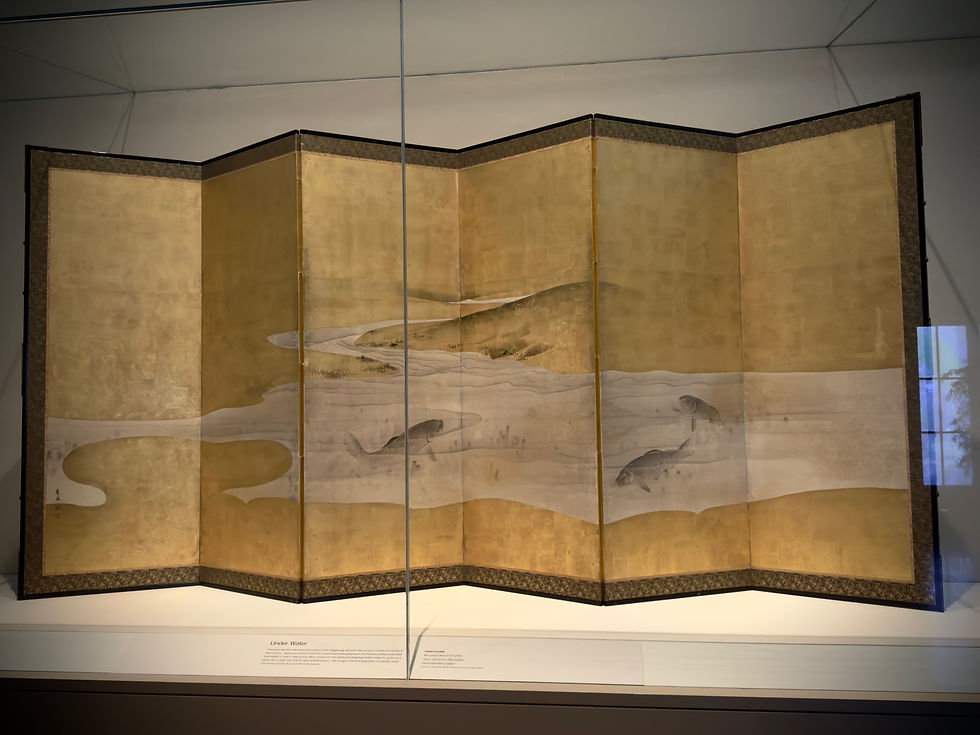
This screen stayed with me while painting Ornamental Koi—its quiet refusal of surface drama, and its trust that meaning emerges slowly, through depth rather than display.


The Freer Gallery is one of my favorite places to visit. Just a small part of it exists above ground, heralded by the now modest Freer Mansion that lines the Smithsonian Mall. A little way down, one may emerge from an even more unobtrusive exit at the Asian Art or African Art Museums, into a walled garden overlooked by a castle. Underground, one may explore a labyrinthine maze of halls, galleries, and classrooms. To visit Whistler’s Peacock Room, or sit in a Buddhist Shrine, to sip Matcha at the Moongate Café, or to simply escape the cold for a few blocks by making one’s way underground to the Hirshhorn.


Comments